
With risks from climate change mounting, there is growing interest in emerging approaches to cool the planet, known as sunlight reflection methods (SRM) or solar geoengineering. What are these approaches, and what could they mean for West Africa?
March 2026
Prepared by SRM360 and the African Climate Intervention Research Hub
Key messages
Increasing risks
In West Africa, agriculture and human health are particularly vulnerable to climate change. Emissions cuts, while essential, are unable to fully address the worsening climate impacts that threaten the region.
Weighing risks against risks
SRM has the potential to reduce many climate risks, but would also introduce new risks. These should be carefully weighed against the impacts of climate change without SRM.
Engaging with the discussion
Building on efforts to increase the involvement of African expertise and priorities is key to shaping a global SRM discussion that reflects those most affected by climate risks.
The climate context
The world is fast approaching 1.5°C of warming and is on track for about 2.8°C under current policies.[1] Threats from climate change are increasing globally, with weather becoming more extreme, sea levels rising, and tipping points approaching.
West Africa has a hot climate and is home to many poorer countries that are less able to adapt to climate change. This leaves the region among the most vulnerable to climate change, despite its limited contribution to the problem. It faces many risks, including impacts on agriculture and health.
Strategies to tackle climate change
This illustrative diagram explores the potential contributions of different climate strategies over the long term:
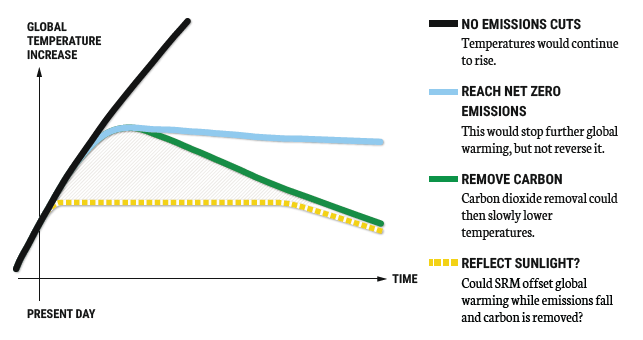
The main strategy to address climate change is cutting carbon dioxide emissions; there cannot be a sustainable solution to the climate crisis without emissions cuts. Reaching net zero emissions would stop further global warming, but would not reduce temperatures to safer levels.[2]
Achieving such a reduction would require also removing hundreds of billions of tonnes of carbon dioxide from the atmosphere, which would be extremely costly and could take more than a century.[3]
SRM may offer a way to cool the planet relatively quickly, but comes with trade-offs and challenges. Could it help as an additional measure to tackle climate change?
What is SRM?
SRM is a set of potential approaches to cool the planet by increasing the amount of sunlight the Earth reflects back to space. If deployed wisely, it could reduce many impacts of climate change, but it comes with new risks and challenges.
Two approaches have received particular attention.
Stratospheric aerosol injection (SAI)
A global intervention
Marine cloud brightening (MCB)
A regional intervention
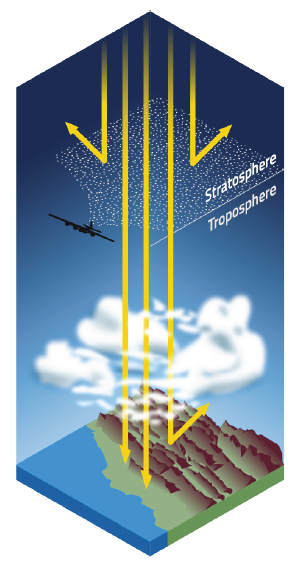
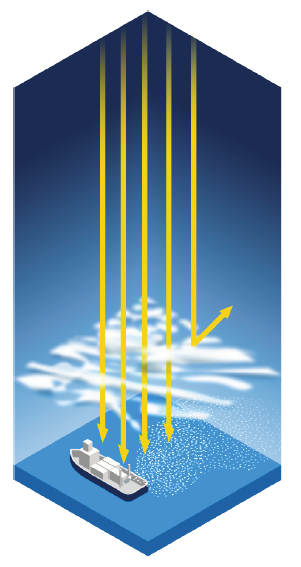
What’s the idea?
A global layer of tiny particles in the upper atmosphere to directly reflect a small fraction of sunlight before it heats the Earth.
More reflective ocean clouds to provide regional cooling, which could potentially be scaled up to a global level.
How could it be done?
By a fleet of specially designed high-flying planes releasing tiny reflective particles that would stay in the stratosphere for 1–2 years.[4]
By a fleet of ships with specially designed sprayers delivering precisely sized sea-salt particles into low-lying ocean clouds.[7]
Would it work?
Researchers are confident that this would be technically feasible and capable of lowering global temperatures,[5] estimating a cost of tens of billions of dollars per year.[4]
Researchers are not currently confident this would be technically feasible.[5]
What are the drawbacks?
It would have several side effects, and some regions would likely see greater changes to rainfall compared to climate change alone.[6]
Its patchy, regional cooling effect could substantially shift rainfall patterns, and it may be less effective or counter-productive in some cases.[8]
How might SAI affect West Africa?
This table outlines how West Africa’s agriculture and health could be affected by SAI compared to future climate change.
What impacts would climate change have?
What impacts would SAI have?
AGRICULTURE
Water scarcity
West Africa is reliant on rain-fed agriculture, which is expected to suffer due to worsening droughts and more variable rainfall under climate change.[9]
Climate models suggest that SAI would introduce complex and uncertain changes in rainfall extremes, including droughts, in West Africa.[10]
Monsoon impacts
The West African Monsoon plays a key role in the region’s agriculture and is of broader socioeconomic importance. Its rainfall is expected to increase in some places and decrease in others.[11]
SAI would be expected to decrease monsoon rainfall in West Africa by a few percent due to its impact on related wind patterns.[12] It could also change the monsoon’s timing and duration by a few days.[12]
Crop yields
Many studies have found that climate change would decrease staple crop yields in West Africa, though adaptation strategies might be able to offset these impacts.[13]
One study found that SAI could improve crop performance and related economic outcomes in West Africa.[14]
HEALTH
Extreme heat
Extreme heat in West Africa is expected to become more intense, more frequent, and longer lasting, resulting in many deaths each year across the region.[15]
SAI could reduce the intensity, frequency, and duration of extreme heat in West Africa.[16]
Malaria spread
The spread of malaria under future climate change is expected to generally decrease in West Africa, though some countries may see increases.[17]
The cooling effect of SAI could reduce malaria transmission in some regions, but could increase the risk in West Africa.[18]
Health outcomes
Climate change is expected to continue to significantly worsen life expectancy and infant mortality in West Africa.[19]
The overall health outcomes of SAI are uncertain, particularly on a regional scale.[18]
Issues and Challenges
While SRM could reduce many climate impacts, it raises several concerns, including side effects and governance challenges.
Physical effects
- SAI could reduce the rainfall changes expected under climate change overall, but could worsen them in some places.[6] Deployed unevenly, SRM could produce substantial shifts in rainfall patterns.
- SAI could delay the recovery of the ozone hole and add a little to air pollution, though these risks may be small compared to the benefits of reduced heat.[20]
Sociopolitical concerns
- There is a concern that advancing SRM would undermine efforts to cut emissions, known as mitigation displacement or moral hazard.[21]
- SRM deployment would have impacts across the world and countries might not cooperate to make decisions fairly or effectively.[22]
- The benefits and risks of SRM would be uneven, which could increase tensions between countries.[23] The attribution of SRM’s impact may also be contested, which could pose further geopolitical risks.[22]
- Large-scale SRM would need to be reliably maintained, as an abrupt and long-lasting stop would cause a “termination shock” – a rapid increase in temperature with devastating effects for the planet.[24]
Considering these concerns and the potential impacts of climate change in the region, many African scientists advocate for more research and engagement on SRM, particularly as it pertains to Africa.[25] Evidence produced through African-led research can inform policy positions, including those of the African Ministerial Conference on the Environment.
Appendix
Additional reading: Learn more about SRM in SRM360’s introductory guide at SRM360.org/guide/why-consider-srm
For the online version of this primer, visit SRM360.org/primer/west-africa
Endnotes:
- UNEP. (2025). Emissions Gap Report 2025. https://www.unep.org/resources/emissions-gap-report-2025
- Palazzo Corner S, Siegert M, Ceppi P, et al. (2023). The zero emissions commitment and climate stabilization. Frontiers in Science. 1:1170744. https://doi.org/10.3389/fsci.2023.117074
- IPCC. (2022). Summary for Policymakers. In: Climate Change 2022: Mitigation of Climate Change. Contribution of Working Group III to the Sixth Assessment Report of the Intergovernmental Panel on Climate Change [Shukla PR, Skea J, Slade R, et al. (eds.)]. Cambridge University Press. http://doi.org/10.1017/9781009157926.001
- Smith W. (2020). The cost of stratospheric aerosol injection through 2100. Environmental Research Letters. 15(11):114004. https://doi.org/10.1088/1748-9326/aba7e7
- Parson EA, Keith DW. (2024). Solar geoengineering: History, methods, governance, prospects. Annual Review of Environment and Resources. 49. https://doi.org/10.1146/annurev-environ-112321-081911
- Irvine PJ, Keith DW. (2020). Halving warming with stratospheric aerosol geoengineering moderates policy-relevant climate hazards. Environmental Research Letters. 15(4):044011. https://doi.org/10.1088/1748-9326/ab76de
- Claudel C, Lockley A, Hoffmann F, Xia Y. (2024). Marine-cloud brightening: an airborne concept. Environmental Research Communications. 6(3):035020. https://doi.org/10.1088/2515-7620/ad2f71
- Wan JS, Chen CC, Tilmes S, et al. (2024). Diminished efficacy of regional marine cloud brightening in a warmer world. Nature Climate Change. 14(8):808-14. https://doi.org/10.1038/s41558-024-02046-7
- Tefera ML, Seddaiu G, Carletti A, Awada H. (2025). Rainfall variability and drought in West Africa: challenges and implications for rainfed agriculture. Theoretical and Applied Climatology. 156(1):41. https://doi.org/10.1007/s00704-024-05251-8
- Nkrumah F, Quagraine KA, Leger Davy Quenum GM, et al. (2025). Assessing regional climate trends in West Africa under geoengineering: A multimodel comparison of UKESM1 and CESM2. Journal of Geophysical Research: Atmospheres. 130(13):e2024JD043117. https://doi.org/10.1029/2024JD043117
- Akinsanola AA, Zhou W. (2019). Ensemble-based CMIP5 simulations of West African summer monsoon rainfall: current climate and future changes. Theoretical and Applied Climatology. 136(3):1021-31. https://doi.org/10.1007/s00704-018-2516-3
- Adeliyi TE, Akinsanola AA. (2026). Sensitivity of projected Afro-Asian monsoon precipitation to solar radiation management. Science of The Total Environment. 1024:181634. https://doi.org/10.1016/j.scitotenv.2026.181634
- Carr TW, Mkuhlani S, Segnon AC, et al. (2022). Climate change impacts and adaptation strategies for crops in West Africa: a systematic review. Environmental research letters. 17(5):053001. https://doi.org/10.1088/1748-9326/ac61c8
- Ayedun RF, Abiodun BJ, Xia L. (2026). Potential impacts of stratospheric aerosol injection on crop yields and related economic outcomes in Africa. Environmental Research: Climate. https://doi.org/10.1088/2752-5295/ae4921
- IPCC. (2023). Africa. In: Climate Change 2022 – Impacts, Adaptation and Vulnerability: Working Group II Contribution to the Sixth Assessment Report of the Intergovernmental Panel on Climate Change. Cambridge: Cambridge University Press; p. 1285–456. https://doi.org/10.1017/9781009325844.011
- Alamou EA, Zandagba JE, Biao EI, et al. (2022). Impact of stratospheric aerosol geoengineering on extreme precipitation and temperature indices in West Africa using GLENS simulations. Journal of Geophysical Research: Atmospheres. 127(9):e2021JD035855. https://doi.org/10.1029/2021JD035855
- Diouf I, Adeola AM, Abiodun GJ, et al. (2022). Impact of future climate change on malaria in West Africa: Impact of future climate change on malaria in West Africa. Theoretical and Applied Climatology. 147(3):853-65. https://doi.org/10.1007/s00704-021-03807-6
- Carlson CJ, Colwell R, Hossain MS, et al. (2022). Solar geoengineering could redistribute malaria risk in developing countries. Nature Communications. 13(1):2150. https://doi.org/10.1038/s41467-022-29613-w
- Fagbemi F, Olufolahan TJ, Akinyele OD, Olatunde OS. (2025). Climate-sensitive health outcomes in West Africa: additional evidence that climate action cannot be delayed. Sustainable Geosciences: People, Planet and Prosperity. 1:100002.https://doi.org/10.1016/j.susgeo.2025.100002
- Harding A, Vecchi GA, Yang W, Keith DW. (2024). Impact of solar geoengineering on temperature-attributable mortality. Proceedings of the National Academy of Sciences. 121(52):e2401801121. https://doi.org/10.1073/pnas.2401801121
- Irvine P, Felgenhauer T, Turner M. (2024). Mitigation Displacement: Could SRM Undermine Emissions Cuts? SRM360.org https://srm360.org/article/mitigation-displacement-could-srm-undermine-emissions-cuts/
- Corry O, McLaren D, Kornbech N. (2024). Scientific models versus power politics: How security expertise reframes solar geoengineering. Review of International Studies. 1-20. https://doi.org/10.1017/S0260210524000482
- Morrissey W. (2024). Avoiding atmospheric anarchy: Geoengineering as a source of interstate tension. Environment and Security. 2(2):291-315. https://doi.org/10.1177/27538796231221597
- Parker A, Irvine PJ. (2018). The risk of termination shock from solar geoengineering. Earth’s Future. 6(3):456-67. https://doi.org/10.1002/2017EF000735
- Klutse NAB, Babatunde Abiodun B. (2025). SRM Research in Africa Is Not Neo‑Colonial Experimentation. SRM360.org. https://srm360.org/perspective/srm-research-africa-not-neo-colonial-experimentation/